BOARD GUIDE · 3D ROBOTICS SIMULATOR
STM32 Blue Pill simulator and pin guide
STM32 Blue Pill is a compact board built around the STM32F103C8T6 32-bit Cortex-M3 microcontroller. It offers timer, serial and analog features in a small footprint, often at a very low price, and is popular for learning embedded development beyond the Arduino AVR family.
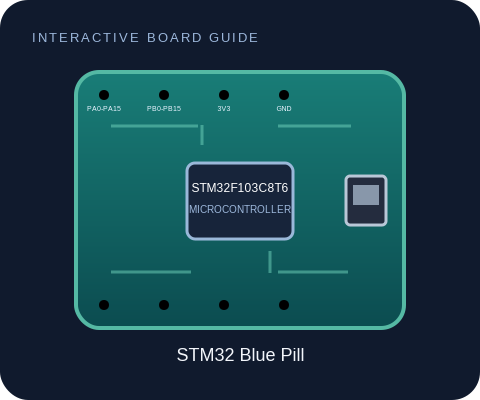
STM32 Blue Pill specifications
These core specifications help you decide whether the STM32 Blue Pill fits your robotics project. Compare processor speed, available memory, I/O count, analog support, wireless connectivity and logic voltage before choosing sensors or motor-control hardware.
| Microcontroller | STM32F103C8T6, Cortex-M3 |
|---|---|
| Clock speed | 72 MHz |
| Flash | 64 KB* |
| RAM | 20 KB |
| GPIO | 32 |
| Analog inputs | 10 (12-bit) |
| Wireless | None |
| Logic voltage | 3.3 V |
| Typical board price | ≈ $2–3 |
STM32 Blue Pill pinout and voltage guide
Blue Pill headers expose GPIO across ports A and B, with some alternate functions shared by timers, USART, I²C and SPI. The board uses 3.3 V signals. Check the exact pin map and boot jumpers before flashing or wiring. Blue Pill pins share alternate timer, USART, I²C and SPI functions across PA and PB ports; select the required peripheral mapping before wiring.
- 3.3 V GPIO; do not apply 5 V signals
- BOOT0 controls the system boot mode
- SWD provides a reliable debug/programming path
- Timer and alternate-function pins are shared
Plan a wiring workflow for STM32 Blue Pill
STM32 Blue Pill pin names combine ports and pin numbers, such as PA0 or PB6, and many pins have alternate timer, UART, I²C or SPI functions. Build from the exact board pin map rather than a generic STM32 diagram. BOOT0 selects startup behavior, and the two boot jumpers should be returned to normal flash boot after using the system bootloader.
First project using STM32 Blue Pill
A timer-based encoder reader or sensor controller demonstrates why Blue Pill is useful beyond a first Arduino sketch. Use a timer input to count pulses, a UART to report measurements and an SWD debugger to inspect firmware state. Start with a known-good board definition and programmer; clones may vary in USB boot support and available flash.
STM32 Blue Pill comparison and alternatives
Blue Pill offers a 32-bit Cortex-M3 and flexible timers in a very small package, often at a low price. Pico has a smoother beginner path and more widely familiar MicroPython support; ESP32 adds wireless networking. Blue Pill is attractive when you want to learn STM32 peripherals or need timer and serial features without paying for a wireless development board. Compare STM32 Blue Pill with Raspberry Pi Pico.
STM32 Blue Pill troubleshooting
If USB flashing does not work, check BOOT0, reset the board after changing jumper positions, and confirm whether your clone supports the expected USB bootloader. A programmer connected through SWD is a reliable alternative. Do not trust advertised flash size on every clone, and never assume the 3.3 V GPIO can tolerate a 5 V sensor output.
What can you build with STM32 Blue Pill?
Choose Blue Pill for firmware experiments, compact sensor systems, timer-heavy control or projects that need more peripheral flexibility than a basic 8-bit board. It can be programmed through a USB-serial adapter or an SWD debugger.
Make a pulse counter for a wheel encoder: route the encoder signal to a timer-capable input, report counts over UART, then inspect the firmware with an SWD debugger. Keep sensor signals within the board’s 3.3 V limits.
STM32 Blue Pill simulator: limits and safe wiring
Clone quality and actual flash capacity vary despite familiar chip markings. USB boot and BOOT0 jumper behavior can confuse first-time setup. Treat every GPIO as 3.3 V-only and check the specific board revision before powering it. Blue Pill clones may differ in fitted components and usable flash capacity despite similar markings; check the exact chip and board revision before selecting a firmware target.
Explore this board in the Robotics Lab App
The free board explorer shows a rotatable 3D model with component labels. Open the full interactive STM32 Blue Pill lesson for board anatomy, quiz and assembly activities; the Uno R3 course is free, and a one-time course pass unlocks the other seven board courses.
Open STM32 Blue Pill in the 3D simulatorBrowse all eight Arduino, ESP32 and Raspberry Pi board guides